
Why Businesses Need to Understand AI vs Traditional Automation
Many businesses jump directly into AI initiatives expecting transformational results.
However, AI success depends on:
✔ Business Process Maturity
✔ ERP Readiness
✔ Data Quality
✔ Workflow Standardization
✔ Operational Visibility
✔ Governance
Before AI, businesses often need better process foundations.
AI Maturity Journey – From Manual Processes to Agentic AI
Every business evolves through stages of automation maturity.
Stage 1
Manual Operations
Processes rely entirely on human effort.
Stage 2
Workflow Automation
Rule-based business process automation.
Stage 3
Robotic Process Automation (RPA)
Bots automate repetitive tasks across multiple systems.
Stage 4
AI Co-Pilot
AI assists employees with insights and recommendations.
Stage 5
AI Agents
AI can monitor, decide, and execute predefined business actions.
Stage 6
Digital Employees
AI operates as a role-specific virtual workforce member.
Stage 7
Agentic AI
AI coordinates complex multi-step business processes autonomously.
What Is Traditional Workflow Automation?
Traditional workflow automation uses predefined rules to automate predictable business processes.
Example of Workflow Automation
If: Invoice is approved
Then: Send approval email
Key Characteristics of Workflow Automation
✔ Fixed business rules
✔ Structured workflows
Predictable outcomes
✔ Limited flexibility
Common Workflow Automation Examples
✔ Purchase approvals
✔ Email notifications
✔ Approval workflows
✔ Inventory replenishment
Task assignments
Benefits of Workflow Automation
✔ Faster processing
✔ Reduced manual work
✔ Improved consistency
✔ Lower operational costs
Limitations of Workflow Automation
✔ Cannot reason
✔ Cannot learn
✔ Cannot adapt
✔ Cannot answer business questions
What Is Robotic Process Automation (RPA)?
Robotic Process Automation (RPA) uses software bots to mimic human actions across systems.
RPA Example:
An RPA bot can:
- Open applications
- Copy data
- Paste information
- Update records
Benefits of Robotic Process Automation (RPA):
- Eliminates repetitive tasks
- Reduces manual data entry
- Improves speed and accuracy
Limitations of RPA
- Fragile when systems change
- Limited adaptability
- No reasoning capabilities
- No business understanding
What Is an AI Co-Pilot?
An AI Co-Pilot helps employees access information and make decisions faster. Unlike automation, AI Co-Pilots assist users rather than operating independently.
AI Co-Pilot Example
Ask:
"Show me overdue invoices above $10,000."
The AI instantly retrieves and summarizes the information.
Benefits of AI Co-Pilots
- Faster information access
- Improved employee productivity
- Better decision support
- Natural language interaction
Synconics Odoo AI Co-Pilot
Our Odoo AI Co-Pilot allows users to interact with ERP data using conversational AI.
Read More About
Odoo AI Co-Pilot
What Is an AI Agent?
AI Agents go beyond answering questions they can take action.
AI Agent Example
An AI Agent can:
- Monitor incoming leads
- Assign opportunities
- Trigger follow-ups
- Generate reminders
without waiting for user instructions.
Key Characteristics of AI Agents
- Autonomous monitoring
- Event-driven actions
- Context awareness
- Workflow execution
Benefits of AI Agents
- Reduced manual effort
- Faster business execution
- Improved operational consistency
Synconics Odoo AI Agents
We build AI Agents for:
- Sales
- Finance
- Procurement
- Inventory
- HR
- Operation
What Are
Digital
Employees?
Digital Employees are AI-powered virtual workers designed to manage specific business functions.
AI Finance EmployeeMonitors:
|
AI Procurement EmployeeMonitors:
|
AI HR EmployeeSupports:
|
Benefits of Digital Employees
|
What Is Agentic AI?
Agentic AI represents the next evolution of enterprise AI. Instead of performing isolated tasks, Agentic AI coordinates multiple systems, workflows, and business objectives.
How Agentic AI Works
Agentic AI can:
- Analyze
- Plan
- Coordinate
- Execute
- Monitor
- Escalate
Agentic AI Example in Odoo
When a customer places an order, Agentic AI can:
- Validate inventory
- Review customer history
- Generate procurement requests
- Notify warehouse teams
- Update dashboards
- Escalate business risks
Benefits of Agentic AI
- Significant productivity gains
- Reduced operational delays
- Improved cross-functional coordination
- Better business visibility
AI vs Automation – What Is the Difference?
Capability | Workflow Automation | RPA | AI Co-Pilot | AI Agent | Digital Employee | Agentic AI |
Rule-Based Actions | ✔ | ✔ | Partial | ✔ | ✔ | ✔ |
Conversational Interface | ✗ | ✗ | ✔ | ✔ | ✔ | ✔ |
Decision Support | ✗ | ✗ | ✔ | ✔ | ✔ | ✔ |
Autonomous Actions | ✗ | Limited | ✗ | ✔ | ✔ | ✔ |
Continuous Monitoring | ✗ | ✗ | ✗ | ✔ | ✔ | ✔ |
Multi-Step Reasoning | ✗ | ✗ | Limited | Limited | Limited | ✔ |
Human-in-the-Loop AI – The Synconics Approach
We believe AI should enhance human capabilities, not replace them.
Our AI Transformation Principles
- Automate repetitive work
- Improve decision-making
- Maintain accountability
- Increase productivity
- Keep humans in control
This approach delivers sustainable and responsible AI adoption.
Why Odoo Is the Foundation for Successful AI Adoption
AI is only as effective as the data and processes behind it.
Odoo provides:
- Centralized business data
- Connected operations
- Standardized workflows
- Process visibility
- Automation capabilities
ERP Readiness Comes Before AI Readiness
Before implementing AI, organizations should ensure:
- Data quality
- Process maturity
- Workflow standardization
- ERP optimization
Synconics AI Transformation Framework
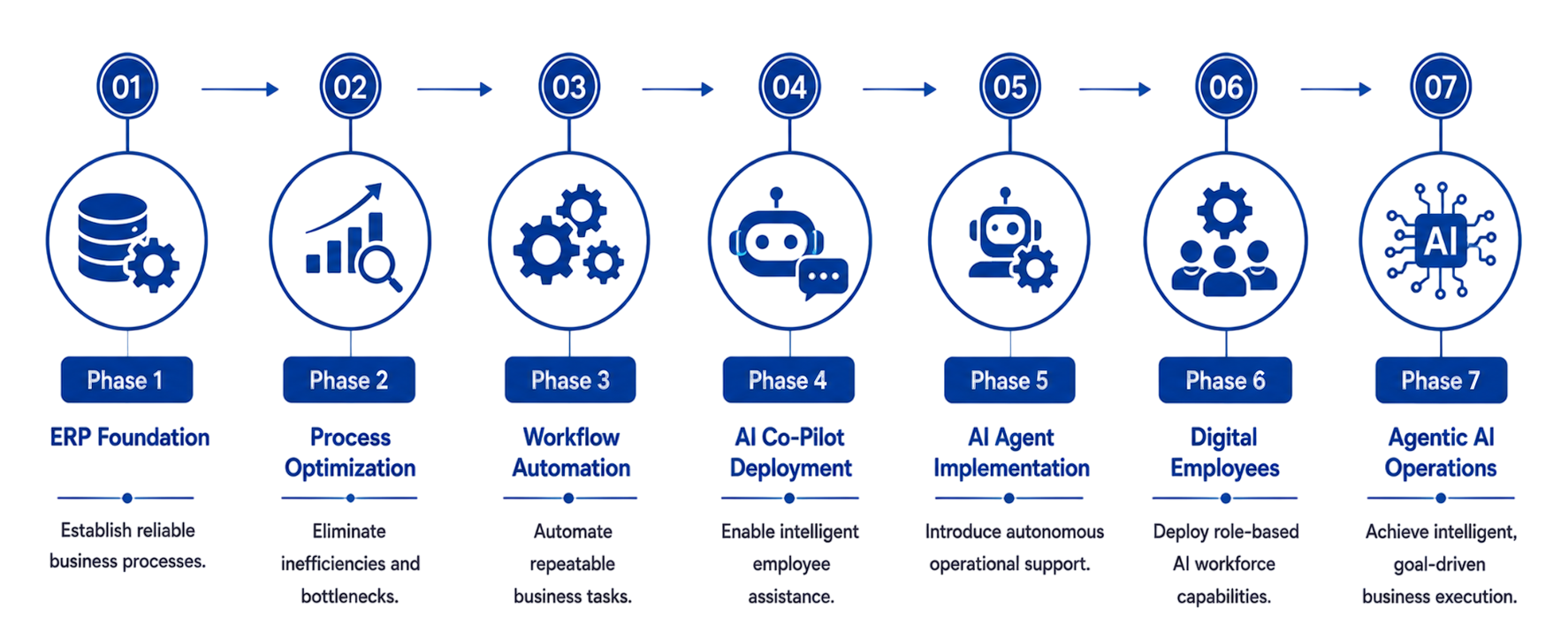
Ready to Build an AI Strategy That Delivers Real Business Value?
Whether you're exploring workflow automation, AI Co-Pilots, AI Agents, Digital Employees, or Agentic AI, Synconics helps organizations create measurable AI transformation roadmaps built on Odoo.
CTA Buttons:
Frequently Asked Questions (FAQs) About Odoo AI vs Traditional Automation
Not always. Traditional automation is often the best solution for predictable and structured processes. AI becomes valuable when adaptability, reasoning, and decision support are needed.
In many cases, Odoo workflows and integrations reduce the need for RPA. However, some legacy-system scenarios may still benefit from RPA.
An AI Agent performs specific tasks and workflows. A Digital Employee manages broader responsibilities within a department or business function.
Begin with an AI Readiness Assessment to identify high-impact opportunities, assess ERP readiness, and create a practical AI transformation roadmap.
